From UNI EN 15232 to ISO 52120
20% of the energy consumed by buildings in Europe is wasted, which amounts to around 270 billion euros every year. BACS is a cost-effective technology (on average €28.7 per m2) with a rapid payback time, on average 3 years, and reduces the waste of thermal and electrical energy.
BACS can reduce energy consumption up to:


From UNI EN 15232 to ISO 52120
But the standard does not stop at a mere list of functions and correction factors for the requirement. The standard illustrates what a building’s system should always do, that is, produce and distribute all and only the energy required by the user.

From UNI EN 15232 to ISO 52120
In particular, the directive specifies:
- a structured list of building control, automation, and technical management functions that contribute to the energy performance of buildings; the functions have been classified and structured according to the building services and their automation and control (BAC);
- a method for defining the minimum requirements or any other specification regarding the control, automation, and technical management functions of the building that contribute to its energy efficiency, which can be used in buildings of different complexity;
- a factor-based method for an initial estimate of the effect of the aforementioned functions in types of buildings with typical use profiles;
- detailed methods for analytically evaluating the effect of the aforementioned functions on a given building.

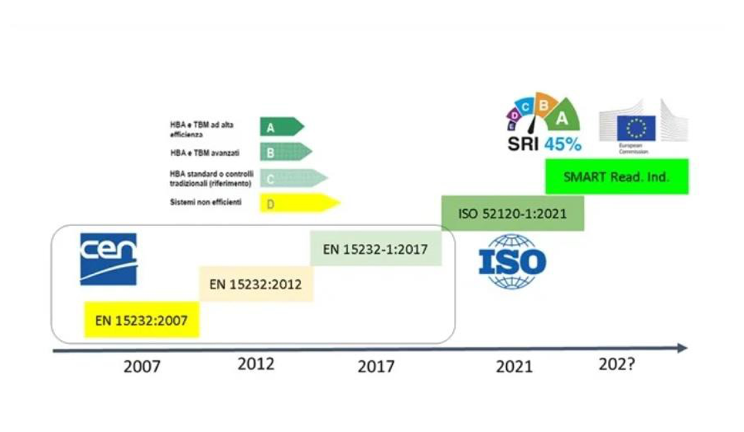
The standard defines four different BACS efficiency classes of functions (A, B, C, D), for residential and non-residential buildings:
Class A “HIGH ENERGY PERFORMANCE”: corresponds to “high energy performance” BAC and TBM (Technical Home and Building Management) systems, i.e., with levels of precision and completeness of automatic control such as to guarantee high energy performance to the system. “Room control devices must be able to manage HVAC systems taking into account various factors (for example, set values based on occupancy detection, air quality, etc.) and include integrated additional functions for multidisciplinary relationships between HVAC and various building services (e.g., electricity, lighting, solar shading, etc.)”;
Class B “ADVANCED”: includes systems equipped with an advanced automation and control system (BACS) and also equipped with some specific technical building management (TBM) functions for centralized and coordinated management of individual systems. “Room control devices must be able to communicate with the building automation system”;
Class C “STANDARD” (reference): corresponds to systems equipped with “traditional” building automation and control systems (BACS), possibly equipped with a communication BUS,1 however with minimum performance levels compared to their real potential;
Class D “NON ENERGY EFFICIENT”: includes traditional technical systems without automation and control, which are not energy efficient.
Calculation methodologies
BACS factor method: This method allows a rapid assessment of the impact of BACS and TBM systems using BAC efficiency factors linked to the annual consumption of the building, based on factors such as air conditioning (heating/cooling), lighting, and ventilation. Each factor is calculated following the relevant standards. For the evaluation, two sets of BAC efficiency factors (fBAC,hc and fBAC,e) are calculated. The first relates to air conditioning, the second to lighting and auxiliary devices.
Detailed method: This procedure should only be used when there is sufficient knowledge of the automation, regulation, and management functions used for the construction and energy systems.
